Official Luthiers Forum!

Owned and operated by Lance Kragenbrink
It is currently Mon Apr 27, 2026 4:28 pm


All times are UTC - 5 hours


Forum rules


Be nice, no cussin and enjoy!


Post new topic Reply to topic  [ 35 posts ]  Go to page 1, 2  Next
Author Message
PostPosted: Tue Dec 04, 2012 10:17 am 
Offline
Brazilian Rosewood
Brazilian Rosewood

Joined: Tue Nov 29, 2005 11:44 am
Posts: 2186
Location: Newark, DE
First name: Jim
Last Name: Kirby
Focus: Build
Status: Amateur
I got a commission for a uke yesterday, and don't quite know where to start. Any guidance from experienced builders would be appreciated. What plans would you think best to start with (either free or purchased). What do you shoot for in order to make a really good one instead of a just OK one?

To complicate things, I'm not sure yet what size I'm building.

My usual projects are classical and flamenco guitars.

Jim

_________________
Jim Kirby
kirby@udel.edu


Top
 Profile  
 
PostPosted: Tue Dec 04, 2012 10:39 am 
Offline
Brazilian Rosewood
Brazilian Rosewood
User avatar

Joined: Thu Feb 12, 2009 12:12 pm
Posts: 3332
First name: Bryan
Last Name: Bear
City: St. Louis
State: Mo
Country: USA
Focus: Build
Status: Amateur
My next project will be an uke (tenor size). I also have no idea what I am doing when it comes to ukes, so I hope you don’t mind me following this one closely. . . Hopefully, you’ll ask all the questions I have so I don’t get the urge to hijack your thread :D .
I’ve been following Tony’s build in the challenge section (shhh don’t tell him), his building approach seems a tad inefficient to me though. He likes to put the top on, bind it then spray the finish. Next he punches it in the face, then re-tops it before binding and finishing. I think I will punch mine in the face before I put the fist top on.
beehive laughing6-hehe

_________________
Bryan Bear PMoMC

Take care of your feet, and your feet will take care of you.


Top
 Profile  
 
PostPosted: Tue Dec 04, 2012 11:00 am 
Offline
Contributing Member
Contributing Member
User avatar

Joined: Tue Oct 12, 2010 9:01 pm
Posts: 3031
First name: Tony
Last Name: C
City: Brooklyn
State: NY
Focus: Build
Status: Amateur
Bryan is right. I do things a bit...how do you say...differently than most people.

If you want to build with a Spanish heel style of neck joint, Hana Lima has plans for that:
http://www.hanalimastore.com/servlet/the-Plans/Categories

I had slapped together a Grizzly ukulele kit for my kids a year ago, and they used a glued butt joint. My kids managed to break the neck off because they use the uke as a weapon more than an instrument. Actually, they never used it as an instrument.

I didn't use plans. I had a mold for a concert uke, so I based my uke off of that. Bolted butt joint for the neck. I used pictures from the internets for the bracing pattern. Pretty much winged it, but my bridge patch lined up with the bridge nicely...much to my surprise. I did retop it but only because the ukulele got mouthy with me after a disagreement over the lousy 'burst I applied to it. ONe thing lead to another, we had been drinking, and BAM!! Left hook right to its big mouthed face. The new top is much nicer. No crappy 'burst either. The uke and I like to refer to it as a "soundboard-ectomy" now and sometimes we laugh about the whole thing.

LMII and Stew mac also have plans but I'm not sure how good they are. Have you searched any of the ukulele-centric forums for advice?

_________________
http://www.CostaGuitars.com
PMoMC


Top
 Profile  
 
PostPosted: Tue Dec 04, 2012 11:19 am 
Offline
Brazilian Rosewood
Brazilian Rosewood
User avatar

Joined: Thu Feb 12, 2009 12:12 pm
Posts: 3332
First name: Bryan
Last Name: Bear
City: St. Louis
State: Mo
Country: USA
Focus: Build
Status: Amateur
Sure they laugh about it now, but just wait:

http://www.co.henry.ga.us/SolicitorGene ... olence.jpg

Do you know if you intend to use a softwood top or hardwood. I havent seen any plans yet, but it is my understanding that some plans suggest different thicknesses (perhaps even bracing?) depending on softwood v. hardwood.

_________________
Bryan Bear PMoMC

Take care of your feet, and your feet will take care of you.


Top
 Profile  
 
PostPosted: Tue Dec 04, 2012 12:39 pm 
Offline
Koa
Koa

Joined: Thu Aug 31, 2006 11:42 pm
Posts: 725
Location: United States
First name: Tom
Last Name: Rein
City: Saline
State: Michigan
Focus: Build
One bit of advice: it will take you just as long to build a uke as to build a guitar, so price it accordingly. All the steps are the same, just smaller. About the only thing you can save money on is materials because we all have wood in our piles that won't make guitars but will work fine for a uke.

_________________
Stay with the happy people.
--Reynolds Large


Top
 Profile  
 
PostPosted: Tue Dec 04, 2012 1:44 pm 
Offline
Cocobolo
Cocobolo

Joined: Thu Feb 09, 2012 4:10 pm
Posts: 285
First name: Chris
Last Name: Reed
City: Stowmarket
State: Suffolk
Zip/Postal Code: IP14 2EX
Country: UK
Focus: Build
Status: Amateur
I'm a hobby builder of ukes and this is some of what I've learnt (usually through bitter experience):

1. The different sizes really are very different. A tenor is much more like a guitar in construction; a soprano is nothing like, and is the hardest to build well. If you're a guitar builder attempting your first uke, a concert or tenor would be more likely to succeed.

2. If you build it like a small guitar it will sound like a small guitar. To make it sound like a uke you really need to build it so that it only just folds up under string tension, and then build the next one just a fraction stronger so it only just doesn't. Tiny linings, minimal bracing, small blocks, and so on. Back and side thickness (or lack of) is as important as top thickness - on the really good ukes I've played they all try to vibrate out of your hands.

3. For a soprano in hardwood (say all mahogany) I'd aim for 1.8mm top, sides and back, but be prepared to go thinner if the top seems very stiff (I want it to flex a little along the grain, and flex easily, though still with some spring) across the grain. At this scale even two consecutive slices from the same board can behave differently, so no hard numbers. A softwood top won't sound like a traditional uke but you can make it sound quite ukey - 2mm or less, flexing as above. I'd use offcuts from the sides as solid linings top and bottom, so 1.8mm for those. Two top braces about 6mm wide, 9 mm high, placed fore and aft of the soundhole, a single back brace at the waist. Bridge patch from soundboard cutoff. In mahogany I can get the total weight down to around 250/260 grams + tuners - that's still on the heavy side, but acceptable!

4. For a concert or tenor I might go thicker by maybe 0.1mm, that's all. Delicate fan bracing with two cross-braces like the soprano. Maybe a stouter lining on the tenor, but I think I could get away with side offcuts.

5. I'd build this with a Spanish heel or a bolt-on neck (single cross-dowel bolt, or whatever they're called, butt joint, no tenon needed).

6. Don't bother with plans - copy a shape you like and modify it to taste. You have to build by feel anyway- following plans will almost always guarantee you an over-built (and thus quiet and a little dead-sounding) uke. I thin down the parts until I start to feel scared, pause until I'm braver and then thin some more. Nothing has yet folded up on me.

If you can get your hands on an old Martin, or a Kumalae from the 20s, or even a good modern Hawaiian uke like a Kamaka or Koaloha, this will give you some idea what you're aiming at. The lightness and overall resonance should be immediately apparent.

If you plan to bind this one then you'll obviously need thicker linings though, but keep them as tiny as you can.


Top
 Profile  
 
PostPosted: Tue Dec 04, 2012 1:47 pm 
Offline
Contributing Member
Contributing Member
User avatar

Joined: Tue Oct 12, 2010 9:01 pm
Posts: 3031
First name: Tony
Last Name: C
City: Brooklyn
State: NY
Focus: Build
Status: Amateur
TRein wrote:
One bit of advice: it will take you just as long to build a uke as to build a guitar, so price it accordingly. All the steps are the same, just smaller. About the only thing you can save money on is materials because we all have wood in our piles that won't make guitars but will work fine for a uke.


Are you speaking from experience? Because it did not take me nearly as long to build the ukulele as it does to build a guitar. There is about a quarter of the sanding to do, less brace work, gluing, finishing, the neck is less than half the size of a guitar as well. I have spoken to a couple of other guys who have built ukes after building guitars and they felt the same way.
It takes me about 9 weeks working at night to get a guitar ready for lacquer. Took me about 3 to get the ukulele to the same point. Am I doing it wrong? idunno

_________________
http://www.CostaGuitars.com
PMoMC


Top
 Profile  
 
PostPosted: Tue Dec 04, 2012 2:31 pm 
Offline
Brazilian Rosewood
Brazilian Rosewood
User avatar

Joined: Thu Feb 12, 2009 12:12 pm
Posts: 3332
First name: Bryan
Last Name: Bear
City: St. Louis
State: Mo
Country: USA
Focus: Build
Status: Amateur
Profchris, thank you very much! This is a lot of great information, and just the stuff I needed to hear. I was planning on not using a plan at all and just winging it; I will keep this post in mind as it is likely to give me the courage to not over do things. I like the idea of thinning until I get scared then waiting until I feel braver!

I’m with Tony on the time thing. I work slow and don’t have much experience, but the guitar shapped mandolin I just finished went way faster than the guitar I made immediately before and the mando required me to draw plans and figure stuff out on the fly. Sanding, and FP were WAY faster. Instead of doing the FP on the back in quarters, the whole back was one section. Neck carving went so fast that I almost felt cheated.

_________________
Bryan Bear PMoMC

Take care of your feet, and your feet will take care of you.


Top
 Profile  
 
PostPosted: Tue Dec 04, 2012 2:42 pm 
Offline
Koa
Koa

Joined: Thu Aug 31, 2006 11:42 pm
Posts: 725
Location: United States
First name: Tom
Last Name: Rein
City: Saline
State: Michigan
Focus: Build
Tony_in_NYC wrote:
TRein wrote:
One bit of advice: it will take you just as long to build a uke as to build a guitar, so price it accordingly. All the steps are the same, just smaller. About the only thing you can save money on is materials because we all have wood in our piles that won't make guitars but will work fine for a uke.


Are you speaking from experience? Because it did not take me nearly as long to build the ukulele as it does to build a guitar. There is about a quarter of the sanding to do, less brace work, gluing, finishing, the neck is less than half the size of a guitar as well. I have spoken to a couple of other guys who have built ukes after building guitars and they felt the same way.
It takes me about 9 weeks working at night to get a guitar ready for lacquer. Took me about 3 to get the ukulele to the same point. Am I doing it wrong? idunno


Tony,
Yes, speaking from experience. I made 2 tenors concurrently and while I thought they would just fall together, they took just as long as a guitar. I built them Spanish-style with no molds and Spanish heel. The next ones, if they happen, will be made with body mold and separate bolt-on neck, which will no doubt speed up the process. I did not want to take the time to make a body mold for these first two but probably should have in retrospect.

_________________
Stay with the happy people.
--Reynolds Large


Top
 Profile  
 
PostPosted: Tue Dec 04, 2012 3:28 pm 
Offline
Contributing Member
Contributing Member
User avatar

Joined: Mon Dec 20, 2010 7:15 pm
Posts: 1041
First name: Gil
Last Name: Draper
City: Knoxville
State: Tennessee
Country: USA
Focus: Build
Status: Professional
Just curious, what is the typical top and back radius, if any, for a uke??


Top
 Profile  
 
PostPosted: Tue Dec 04, 2012 4:51 pm 
Offline
Cocobolo
Cocobolo
User avatar

Joined: Mon Apr 19, 2010 6:04 pm
Posts: 118
Location: Surrey UK
First name: Bob
Last Name: Matthews
State: Surrey
Country: England
Focus: Build
Status: Semi-pro
I made an 8 string tenor uke about a year ago and also didn't use any plans. I designed the outline in a programme called 'G Thang' available here http://liutaiomottola.com/formulae/gthang.htm and decided to make it as lightly built as possible - apart from using guitar type kerfed linings.

I made the sides and back quite thin at 0.065'' (a dream to bend the sides at that dimension).

The top was made out of spruce and thicknessed to 0.080'' - which turned out to be a fraction too thin when strung up to full tension with all 8 strings.
A day after the uke was finished and tuned to gG cC EE AA, I could see telegraphing of the 3 fan braces thro the top behind the bridge, a week after it had been strung up I could see very pronounced telegraphing :shock: To remedy this I fitted two extra fan braces in between the existing ones, which was a nightmare job through the tiny soundhole!
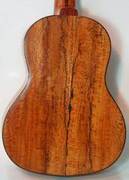
The uke has now held up for nearly 12 months and is very, very loud and musical, I take it to a local uke gathering once a week and thrash the life out of it with a leather pick!

You can see my build process here if you wish. http://bobmatthewsguitars.co.uk/index.php/workshop/in-the-works-ukulele


You do not have the required permissions to view the files attached to this post.

_________________
http://www.bobmatthewsguitars.co.uk


Top
 Profile  
 
PostPosted: Tue Dec 04, 2012 6:59 pm 
Offline
Cocobolo
Cocobolo

Joined: Thu Feb 09, 2012 4:10 pm
Posts: 285
First name: Chris
Last Name: Reed
City: Stowmarket
State: Suffolk
Zip/Postal Code: IP14 2EX
Country: UK
Focus: Build
Status: Amateur
Goodin wrote:
Just curious, what is the typical top and back radius, if any, for a uke??


Nothing typical! Some are completely flat front and back (mine are because that works for me), others have flat tops and radiused backs,some are radiused top and back.

For what my opinion is worth (free, remember) I'd say that a soprano works very well with a flat top, because the size of the soundboard is small enough that reaonable humidity changes don't affect it much. If thin enough it will belly before the bridge and dip aft, and within reason I like to see that on a soprano of any age. A tenor built thin enough to be exciting probably needs some doming.

Early Hawaiian ukes tended to have a pronounced dome to the back, which might add some depth to the sound. But flat works pretty well. However, domed is definitely sexier.


Top
 Profile  
 
PostPosted: Tue Dec 04, 2012 7:05 pm 
Offline
Brazilian Rosewood
Brazilian Rosewood
User avatar

Joined: Thu Jan 06, 2011 6:08 pm
Posts: 2712
First name: ernest
Last Name: kleinman
City: lee's summit
State: mo
Zip/Postal Code: 64081
Country: usa
Focus: Build
Status: Professional
Hope this helps my abt 25 videos on youtube abt making ukes www.ateliertomi.com follow an click on to see youtube videos.Gud luck.


Top
 Profile  
 
PostPosted: Tue Dec 04, 2012 7:10 pm 
Offline
Cocobolo
Cocobolo

Joined: Thu Feb 09, 2012 4:10 pm
Posts: 285
First name: Chris
Last Name: Reed
City: Stowmarket
State: Suffolk
Zip/Postal Code: IP14 2EX
Country: UK
Focus: Build
Status: Amateur
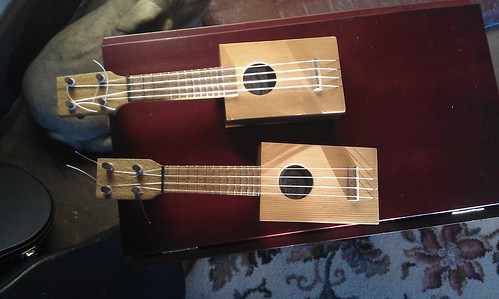
Just to give Bryan some comfort on free-form design, here's a pair of 7 inch scale ukes I made recently:

Image

I've never seen plans for such small beasts - these are just barely playable - but they are loud enough to cut through even when playing with others. Walnut bodies, cedar tops, oak necks and 1/8 rosewood violin tuners.

Here I am demonstrating to an over-impressed relative:


Apologies for the constipated expression, but these babies require some concentration to play!


Top
 Profile  
 
PostPosted: Tue Dec 04, 2012 7:10 pm 
Offline
Contributing Member
Contributing Member
User avatar

Joined: Wed Jan 13, 2010 12:46 am
Posts: 1247
First name: Beth
Last Name: Mayer
City: Tucson
State: AZ
Country: United States
Focus: Build
Status: Amateur
Bob, nice build thread on your website. I really like that rosette!
Profchris, why do you say that building a soprano is the most difficult? I have only built concert and tenor sizes, but had assumed a soprano would be much less difficult due to the less complex bracing.


Top
 Profile  
 
PostPosted: Tue Dec 04, 2012 7:13 pm 
Offline
Cocobolo
Cocobolo
User avatar

Joined: Tue Nov 14, 2006 4:10 am
Posts: 151
Location: United States
First name: Kevin
Last Name: Mason
City: Wheeling
State: IL
Zip/Postal Code: 60090
Country: USA
Focus: Build
Status: Semi-pro
I agree with Tony about the Hana Lima plans. They provide lots of reliable information and following the plan will result is a very nice uke. I would recommend radiusing the top and the back and thicknessing the back and sides to .070" or a bit less. I thickness koa tops to about the same and then thin out to around .060 or less at the perimeter. I've only made one spruce top uke. I can't remember exactly, but I do remember that I kept it thicker. As someone else mentioned, it's all the same things you would do in making a guitar, just less material. Just remember to keep it light.

_________________
Kevin Mason
Mason Guitars and Ukuleles on Facebook
http://masonguitars.net


Top
 Profile  
 
PostPosted: Tue Dec 04, 2012 7:17 pm 
Offline
Contributing Member
Contributing Member
User avatar

Joined: Fri May 18, 2012 8:35 pm
Posts: 2661
First name: D
Last Name: S
State: TX
Country: USA
Focus: Build
Status: Amateur
profchris wrote:
Just to give Bryan some comfort on free-form design, here's a pair of 7 inch scale ukes I made recently:

Image

I've never seen plans for such small beasts - these are just barely playable - but they are loud enough to cut through even when playing with others. Walnut bodies, cedar tops, oak necks and 1/8 rosewood violin tuners.

Here I am demonstrating to an over-impressed relative:


Apologies for the constipated expression, but these babies require some concentration to play!

That is really cool!
Been a while since I laughed so much.

_________________
wah
Wah-wah-wah-wah
Wah


Top
 Profile  
 
PostPosted: Tue Dec 04, 2012 10:11 pm 
Offline
Brazilian Rosewood
Brazilian Rosewood
User avatar

Joined: Wed Feb 20, 2008 9:12 pm
Posts: 7003
First name: Mike
Last Name: O'Melia
City: Huntsville
State: Alabama
Focus: Build
Status: Semi-pro
I'm gonna second that plan from Hana Lima (tenor). I modified it so it was less deep. I did not use the spanish heel. Bolt on neck. I found that I had a lot to learn. But it came out well.

One lesson I learned was that going thin was the key. Ukes are light bodied anyways. But you must get to thin sooner or you will have a hell of a time shaping the little beast. Super soft is your friend... tight radii! Seems to me I was working more on the "edge" given the thiness of the parts.

Mike


Top
 Profile  
 
PostPosted: Tue Dec 04, 2012 10:35 pm 
Offline
Koa
Koa

Joined: Sat Nov 07, 2009 9:34 pm
Posts: 552
City: winnipeg
State: manitoba
Country: canada
Focus: Build
Status: Amateur
Count me in on the Hana Lima plans too. The book is my standard reference, get it and it contains the tenor plans too.

I am using 15 ft radius for both the top and back with good results.

Thickness for a tenor, I use 0.070"(1.78 mm) for mahogany or maple and 0.080" for spruce or cedar.

The Hana Lima tie-through bridge makes a lot of sense.

I use cross-grain veneer (0.025") around the soundhole and for the bridge-patch.

My last four have used falcate bracing with good sound so far.

Good luck

Bob :ugeek:


Top
 Profile  
 
PostPosted: Wed Dec 05, 2012 6:41 am 
Offline
Cocobolo
Cocobolo

Joined: Thu Feb 09, 2012 4:10 pm
Posts: 285
First name: Chris
Last Name: Reed
City: Stowmarket
State: Suffolk
Zip/Postal Code: IP14 2EX
Country: UK
Focus: Build
Status: Amateur
Beth Mayer wrote:
Profchris, why do you say that building a soprano is the most difficult? I have only built concert and tenor sizes, but had assumed a soprano would be much less difficult due to the less complex bracing.


Two reasons. First because Pete Howlett says so, and he builds very serious ukes.

Second is my own much more limited experience. It's easy to build a mediocre soprano, which sounds thin and uninteresting (done that!). To make one that sings properly means building on the edge of structural collapse. The margin you're working with is really very small and the individual characteristics of the wood you are working with are the defining factor, so that each uke is different in terms of thicknessing and bracing from another made from apparently identical materials. On a larger instrument you have a wider margin of "good", so the target is easier to hit.


Top
 Profile  
 
PostPosted: Wed Dec 05, 2012 9:08 am 
Offline
Brazilian Rosewood
Brazilian Rosewood

Joined: Tue Nov 29, 2005 11:44 am
Posts: 2186
Location: Newark, DE
First name: Jim
Last Name: Kirby
Focus: Build
Status: Amateur
Thanks for all the feedback everyone. It looks like I have my work cut out for me, as it looks like a soprano is what will be built.

I wonder if its worth building a few test cases first in order to find the structural limit. I hate the idea of delivering a mediocre one.

_________________
Jim Kirby
kirby@udel.edu


Top
 Profile  
 
PostPosted: Wed Dec 05, 2012 9:33 am 
Offline
Contributing Member
Contributing Member
User avatar

Joined: Tue Oct 12, 2010 9:01 pm
Posts: 3031
First name: Tony
Last Name: C
City: Brooklyn
State: NY
Focus: Build
Status: Amateur
TRein wrote:
Tony,
Yes, speaking from experience. I made 2 tenors concurrently and while I thought they would just fall together, they took just as long as a guitar. I built them Spanish-style with no molds and Spanish heel. The next ones, if they happen, will be made with body mold and separate bolt-on neck, which will no doubt speed up the process. I did not want to take the time to make a body mold for these first two but probably should have in retrospect.


Well the Spanish Heel will slow you down a bit, as will building without a mold if you are not accustomed to doing so. Ovalsoundhole threw together a ukulele in a week working after school and weekends. And I'm not even sure it took that long. I would not call him an experienced ukulele builder but he did have 11 guitars and another uke or two under his belt. Definitely not a first timer.

_________________
http://www.CostaGuitars.com
PMoMC


Top
 Profile  
 
PostPosted: Wed Dec 05, 2012 10:41 am 
Offline
Contributing Member
Contributing Member
User avatar

Joined: Wed Jan 13, 2010 12:46 am
Posts: 1247
First name: Beth
Last Name: Mayer
City: Tucson
State: AZ
Country: United States
Focus: Build
Status: Amateur
profchris wrote:
Beth Mayer wrote:
Profchris, why do you say that building a soprano is the most difficult? I have only built concert and tenor sizes, but had assumed a soprano would be much less difficult due to the less complex bracing.


Two reasons. First because Pete Howlett says so, and he builds very serious ukes.

Second is my own much more limited experience. It's easy to build a mediocre soprano, which sounds thin and uninteresting (done that!). To make one that sings properly means building on the edge of structural collapse. The margin you're working with is really very small and the individual characteristics of the wood you are working with are the defining factor, so that each uke is different in terms of thicknessing and bracing from another made from apparently identical materials. On a larger instrument you have a wider margin of "good", so the target is easier to hit.

When you say to build to the edge of collapse, do you just mean the top, and it's braces? Do you use a bridge patch?


Top
 Profile  
 
PostPosted: Wed Dec 05, 2012 2:07 pm 
Offline
Cocobolo
Cocobolo

Joined: Thu Feb 09, 2012 4:10 pm
Posts: 285
First name: Chris
Last Name: Reed
City: Stowmarket
State: Suffolk
Zip/Postal Code: IP14 2EX
Country: UK
Focus: Build
Status: Amateur
Beth Mayer wrote:
When you say to build to the edge of collapse, do you just mean the top, and it's braces? Do you use a bridge patch?


Top, sides, linings and braces. Blocks too. The neck can be as beefy as you want!

And yes, small bridge patch (see my first post on this thread).

Jim, if you're an experienced builder then go for it first time, but be prepared to reject the first one and have another try. I guess doing something which is as simple as possible might be good for a first try - no binding, maybe even frets direct in neck, in order to cut down the wasted time if it isn't to the standard you want. I've given away some of what I think are failures to friends and they are uncritically delighted with them.

By the way, I forgot to add that the finish plays an important part with sopranos - high gloss tends to be too much, unless you can achieve it in an ultra thin film.

I should end with a disclaimer, because I seem to be laying down the rules in this thread and I am really a very rank amateur. But I am a player and I see two quite different schools of uke owner - those form whom looks are paramount, and those who would happily play the sorriest looking dog if it sounded and played great. I'm in the second camp. If your customer is in the first then she/he might want something that looks just like your guitars and not be so bothered about its sound.If so you can build heavier. Worth finding out before you start!


Top
 Profile  
 
PostPosted: Thu Dec 06, 2012 12:23 am 
Offline
Brazilian Rosewood
Brazilian Rosewood

Joined: Tue Nov 29, 2005 11:44 am
Posts: 2186
Location: Newark, DE
First name: Jim
Last Name: Kirby
Focus: Build
Status: Amateur
profchris wrote:
Beth Mayer wrote:
When you say to build to the edge of collapse, do you just mean the top, and it's braces? Do you use a bridge patch?


Top, sides, linings and braces. Blocks too. The neck can be as beefy as you want!

And yes, small bridge patch (see my first post on this thread).

Jim, if you're an experienced builder then go for it first time, but be prepared to reject the first one and have another try. I guess doing something which is as simple as possible might be good for a first try - no binding, maybe even frets direct in neck, in order to cut down the wasted time if it isn't to the standard you want. I've given away some of what I think are failures to friends and they are uncritically delighted with them.

By the way, I forgot to add that the finish plays an important part with sopranos - high gloss tends to be too much, unless you can achieve it in an ultra thin film.

I should end with a disclaimer, because I seem to be laying down the rules in this thread and I am really a very rank amateur. But I am a player and I see two quite different schools of uke owner - those form whom looks are paramount, and those who would happily play the sorriest looking dog if it sounded and played great. I'm in the second camp. If your customer is in the first then she/he might want something that looks just like your guitars and not be so bothered about its sound.If so you can build heavier. Worth finding out before you start!


Chris,

Thanks for the advice. Being a classical builder, I'm not too much into flash anyway (and the uke would almost certainly be french polished, so hopefully that is light enough finish.)

I suspect that the eventual owner of this first uke is a total novice who wouldn't know what one is really supposed to sound like (not sure I do either). I'm probably out to please myself here as much as anyone else.

_________________
Jim Kirby
kirby@udel.edu


Top
 Profile  
 
Display posts from previous:  Sort by  
Post new topic Reply to topic  [ 35 posts ]  Go to page 1, 2  Next

All times are UTC - 5 hours


Who is online

Users browsing this forum: No registered users and 212 guests


You cannot post new topics in this forum
You cannot reply to topics in this forum
You cannot edit your posts in this forum
You cannot delete your posts in this forum
You cannot post attachments in this forum

Jump to:  
Powered by phpBB® Forum Software © phpBB Group
phpBB customization services by 2by2host.com