|
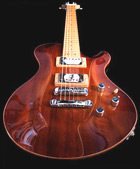
I've been spraying Rockhard for the last 6 guitars, I used to brush it. This is the only finish I use. Yes they've changed the formula, although it looks to me quality control went down as it's slightly different with each can, especially in terms of thickness/fluidity. Colour is the same, it seems a hair more opaque lately with a greenish/bluish hint.
Right out of the can is the perfect consistency for spraying (or used to be…). I use Bloxygen and pour the varnish in Mason jars or similar, and go smaller as I use up the varnish. As it inevitably thickens a tad, I add turpentine as needed to regain the original consistency, as I remember it. Too thick and it won't level properly, too thin and it will run. I do not use Behlen's varnish reducer, pure turpentine (from pine…) works perfectly, and possibly better for my purpose. Depending on your seal coat you can spray the 1st Rockhard coat as it comes out of the can. For subsequent coats I add a bit of acetone, and a bit of turpentine as needed. The acetone, as mentioned, makes witness lines less of an issue as it bites onto the preceding coat. It also makes the varnish cure faster, the turpentine is added to slow that down. I found that for the first few coats a quick sanding with 400 grit or the maroon scotchbrite pads, without trying to level things too much, works best. After 3 or 4 coats I start leveling the finish with 600 wet-or-dry sandpaper (wet…), spray another coat on the thick side, level with 800, another coat and level with 1000. The last coat is sprayed as thick as possible without runs (preferably with varnish from a brand new can). That seems to eliminates issues with witness lines, the very faint ones disappear with buffing anyway.
There are 2 major issues with Rockhard: adhesion, and for those who prefer a clear finish, colour.
The adhesion issues I'm still working on, Bruce uses Behlen's violin varnish (a spirit varnish, really) as a seal coat and IME it improves things a bit compared with pure shellac. On my last guitar I used Waterlox as a sealer and it seems even better, except one really has to wipe oily woods with naptha before applying Waterlox. Otherwise it will take forever to dry, if it ever does, on, say, cocobolo. Waterlox really makes the grain pop out and gives extra depth.
For the colour I will try a new schedule on my next build, which is to use Behlen's restoration varnish (transparent) for the finish build up and Rockhard for the last 3 coats.
From my last conversation with him, Bruce is now using Ace hardware varnish after trying McCloskey spar, and is thinking of going back to Rockhard.
_________________ Laurent Brondel West Paris, Maine - USA http://www.laurentbrondel.com/
|























 Login
Login Register
 FAQ
FAQ




![[:Y:]](./images/smilies/smiley20.gif "Thumbs Up")



 ), but they are talking about this stuff.