Alan Carruth wrote:
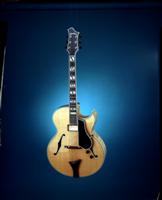
I've worked on a couple of flat top-arch back instruments. One was completing something that somebody else started, and the other was with one of my students. If it weren't so much extra work I'd make more of them.
The two most successful archtop Classicals I've made had top arches that were 15mm high off the bench top (which includes the top thickness) and tops only 3mm thick. The back arches (soft maple and mahogany) were similar.
Note that the 'proper' arch height for the plates depends on how thick you want to make it, not how long the box is. On my first two attempts at archtop Classicals I made the arches high and thin, to get maximum stiffness for minimum weight. It was very hard to get them to 'behave' when I was tuning them. The plates were too thin, and some of he modes, particularly the 'ring' modes, kept buckling in odd places, producing pairs of modes that were 'open' in different ways. The timbre ended up decidedly more 'bluesy' than 'classical': harsh and edgy. They were, however, LOUD.
Then I read Schelling's paper on 'The Violin as a Circuit'. He mentioned (in a footnote!) that to maintain dynamic similarity the arch and thickness should scale together. On the next one I found a low-density piece of spruce and settled on a 3mm thickness. Since violin tops are usually around that thick, and use the 15mm arch, I went that way. It all went 'like budduh', as they say.
I don't know anything about "tuning" plates.I am more of a "seat of my pants" type builder -very Loosey. -Goosey. I build them by "feel" and they come out sounding like guitars-lol






















 Login
Login Register
 FAQ
FAQ